Where does static electricity arise on plastics and film lines?
Plastics are good insulators: charge that forms on their surface does not flow to ground on its own and stays on the material. Charge arises when two surfaces rub against each other, or come into contact and then separate. In plastics and film production, this happens at almost every point on the line:
- Extrusion, film blowing and haul-off: The film becomes charged as it separates from the cooling and haul-off rollers.
- Winding and unwinding: As the reel is wound and unwound, the layers separate from each other; charge can build up layer by layer in the wound reel.
- Coating, laminating, sheet extrusion and slitting: The material passes over a large number of rollers; every separation point is a new source of charge.
- Bag cutting and stacking: Cut bags and sheets rub against each other as they are stacked on top of one another.
- Injection molding, bottling and vacuum forming: Plastic parts coming out of the mold are charged and attract dust from the surroundings.
The accumulated charge generally increases as the line speed rises and the ambient air becomes drier.
Effects on production
Statically charged film, sheet and parts can cause the following problems in production:
- Sticking: Film layers stick to each other, to rollers or to machine parts; winding and cutting quality suffers.
- Dust attraction: A charged surface holds airborne dust strongly. Dust that is not removed before printing, laminating or coating remains as a visible defect in the end product.
- Stacking and feeding faults: Bags and sheets do not stack neatly; several pieces can be drawn in together when they are fed into the machine.
- Operator shocks: Operators who touch the charged material or reel can receive unpleasant electric shocks.
- Uncontrolled discharge: A high charge can discharge as a spark; in environments with flammable vapors or dust, this is also a safety risk.
Solution: which product, where?
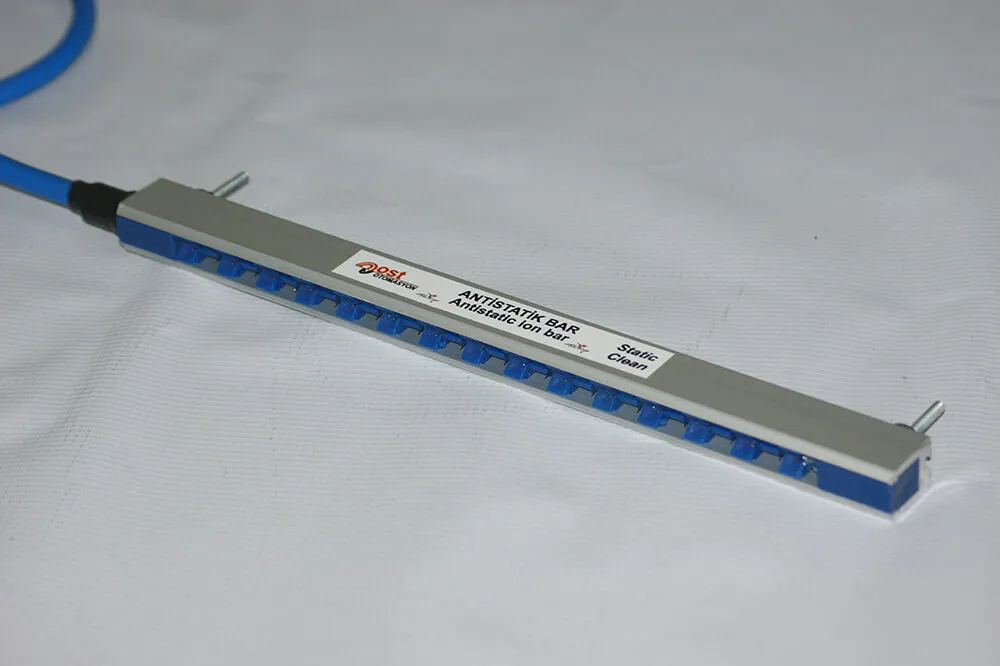
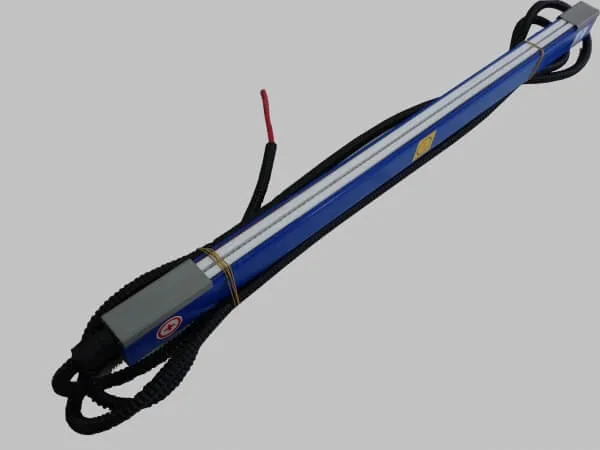
Roller exits and winding points: The most common solution is the antistatic bar. Standard bars work at a maximum distance of 4 cm from the material; if the bar cannot be brought close to the material, air-assisted models extend this distance to up to 50 cm. Because the bars are manufactured in one piece from 10 cm up to 4 m, they can also be fitted as a single piece on wide film lines. The high voltage required is supplied by the AC antistatic power supply.
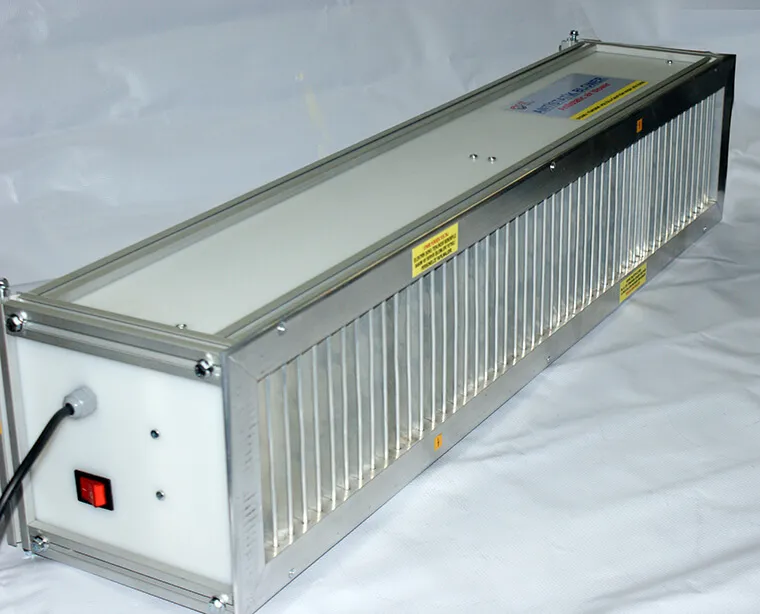
Large areas and long distances: At points where it is difficult to get close to the material, such as XPS lines, sheet extrusion, injection molding and vacuum forming, the ionizing blower blows ionized air from a distance of 1–2 m with fan assistance. It does not need compressed air.
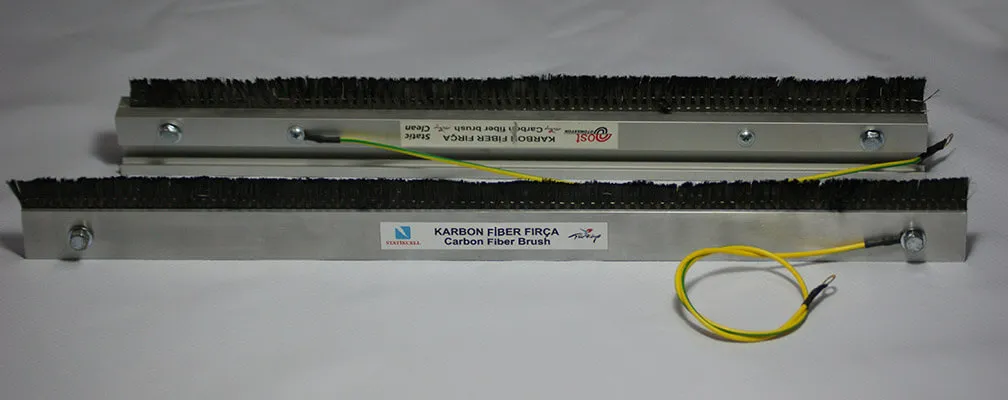
Without an electrical connection: On flat film and sheet, the carbon fiber brush works at a distance of 1 cm from the material, without contact and without needing electricity. Because it may not be sufficient at high line speeds, active ionizers are preferred in those cases.
Tight spaces and part cleaning: At points where a bar cannot fit, the antistatic nozzle is used, and for manual cleaning of plastic sheets and molded parts, the antistatic air gun. Both have an effective distance of 500 mm and work with 5–6 bar of dry, clean compressed air.
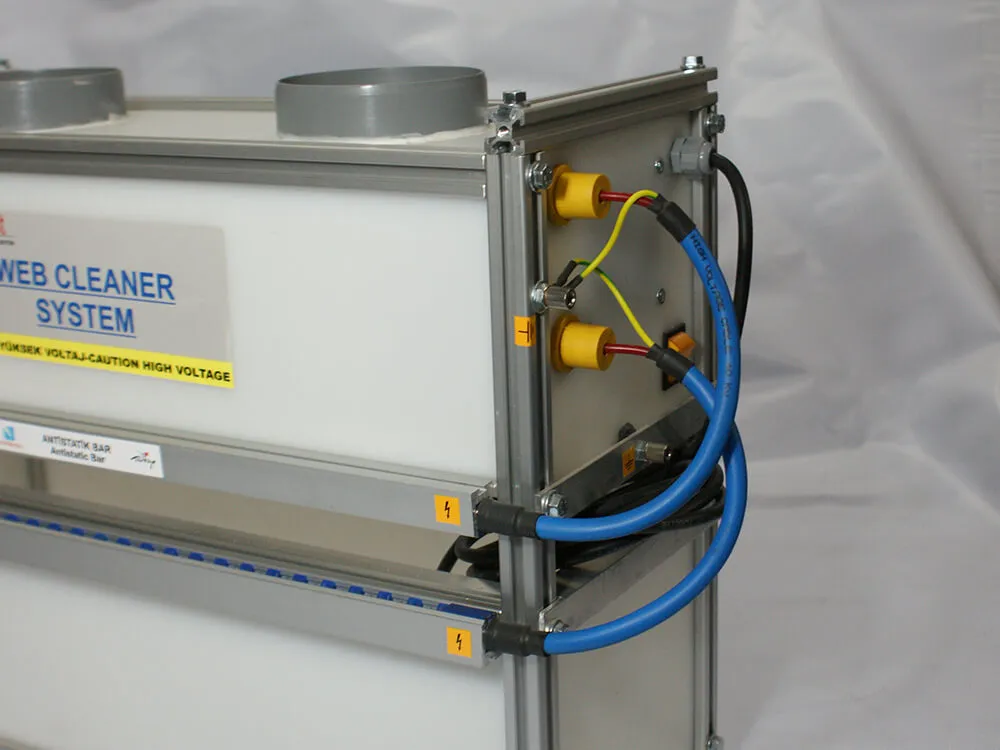
Dust before printing and laminating: The web cleaner eliminates the charge with ionizing bars, dislodges dust from the surface with compressed air and removes it with an extraction system. It is manufactured in single-sided or double-sided versions.
Holding layers together: In applications such as double-layer bags, bag cutting, stacking and automatic reel changing, the aim is not to eliminate the charge but to keep the layers together without slipping. For this, the DC static charging bar is used together with the DC static charging power supply.
| Problem | Solution | Product |
|---|---|---|
| Film sticks at the roller or reel exit | Close-range neutralization (up to 4 cm) | Antistatic bar |
| Bar cannot be brought close to the material | Ions carried by compressed air (up to 50 cm) | Air-assisted antistatic bar |
| Large area, mounting far from the material | Fan-driven ionized air (1–2 m) | Ionizing blower |
| Dust before printing or laminating | Neutralization, air and extraction | Web cleaner |
| Bag layers slip, stacks fall apart | Static charging (pinning) | DC charging bar and DC power supply |
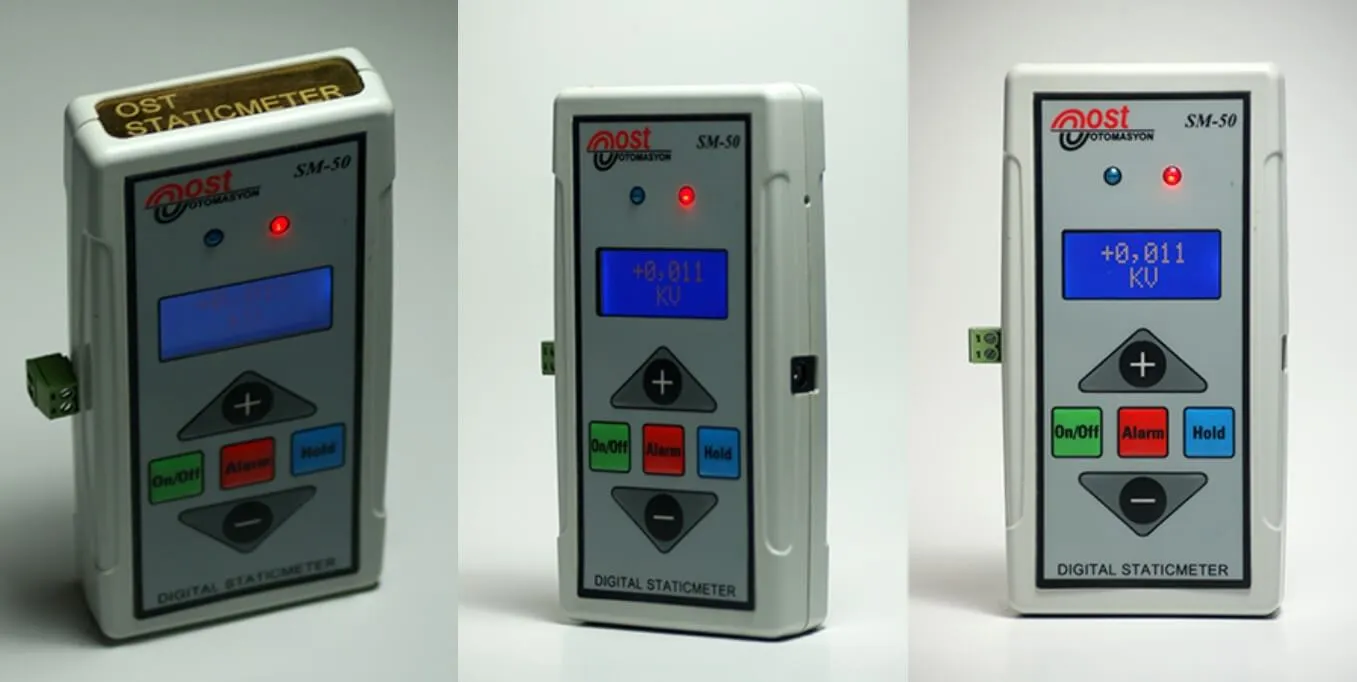
| Location and polarity of the charge unknown | Measurement | Static meter |
For the right solution
To determine the right product and bar length for your application, all we need is the following information: the type of material processed (film, sheet, bags, etc.), the material or reel width, the line speed, the mounting distance between the equipment and the material, and whether compressed air is available on the line. A measurement taken with a static meter at the point where the problem occurs speeds up diagnosis by showing the level and polarity of the charge.
Send us the information via the contact form, and we will assess your application together.