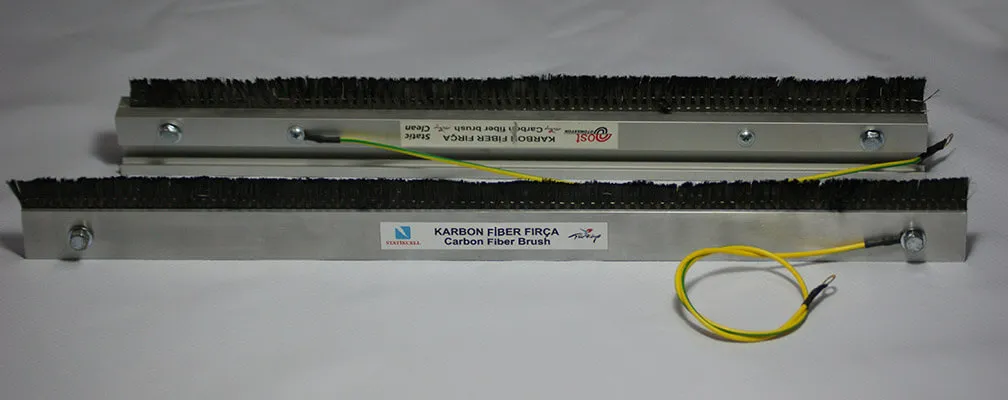
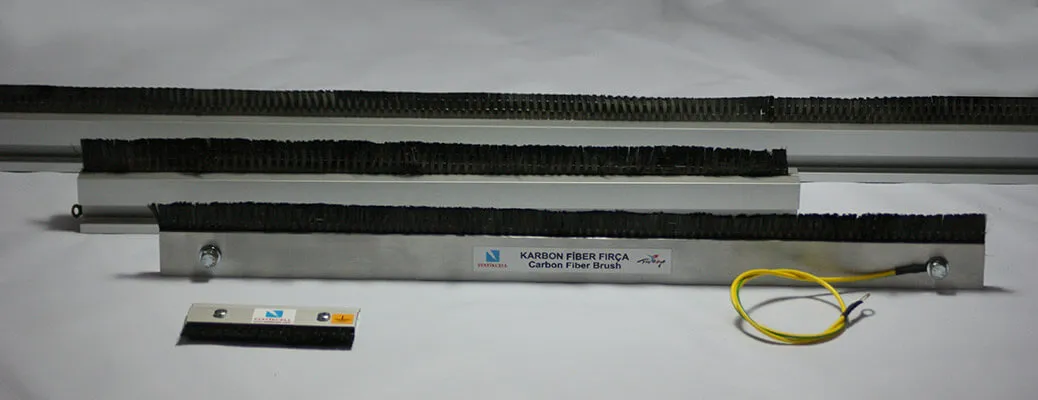
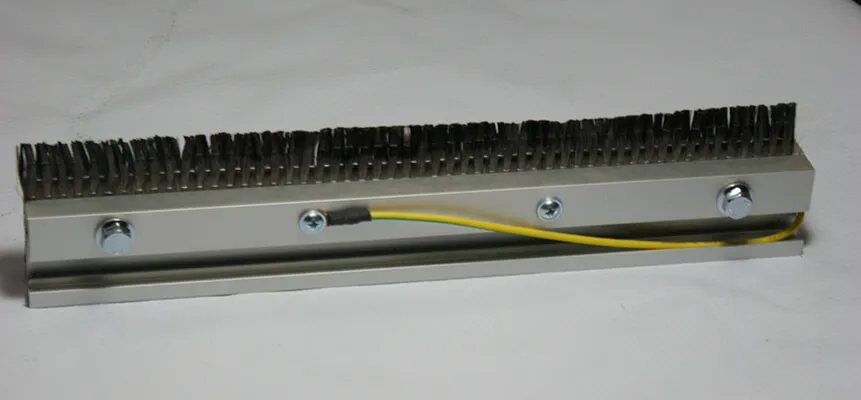
The antistatic carbon fiber brush is an exproof (ATEX certification in progress) static eliminator that needs no electricity, designed for use in areas with a high risk of fire and explosion. Its carbon fiber bristles are grounded through the body and, thanks to their high conductivity, neutralize the static electricity on the material. The brush can be manufactured in one piece up to 6 m, and the standard bristle length of 20 mm can be extended on request. The brush is non-flammable, does not shed and, thanks to its high flexibility, does not break.
How does a carbon fiber brush work?
The carbon fiber brush works as a passive (induction-based) static eliminator. When a statically charged material passes close to the brush, the electric field created by the surface charge concentrates at the fine, conductive and grounded carbon fiber tips. When the field is strong enough, the air around the bristle tips is ionized. Ions of the opposite polarity to the charge on the material are attracted to the surface and neutralize the charge. For this process to work continuously, the bristles must be connected to ground through the body and the grounding cable.
Because the material’s own charge starts the ionization, no power supply or high-voltage cable is needed. This makes the brush a suitable option for environments where the risk of sparks from electrical sources must be kept to a minimum. The brush works without contact, at a distance of approximately 1 cm from the material.
Where are carbon fiber brushes used?
The carbon fiber brush can be used to remove static electricity from any flat material in sheet or film form that has no recesses or protrusions. Insulating materials such as plastic film pick up static charge as they unwind from the reel or separate from rollers. This charge can cause the film to attract dust, stick to machine parts and produce uncontrolled discharges.
In areas with a high risk of fire and explosion, static electricity is also a safety issue: a discharge spark from a charged surface can ignite flammable vapors or dust in the atmosphere. The carbon fiber brush, which needs no electricity, is designed for use as a static prevention device in such areas. Because it can be fitted to other materials of the customer’s choice as well as the standard aluminum profile, it is also easy to adapt to different machine designs.
Limitations and choosing correctly
As with any passive static eliminator, the carbon fiber brush has limits you should be aware of. The product’s limitations are that it may not be sufficient at high speeds and that it works at a close distance of 1 cm. Also, because the material’s own charge starts the ionization, the effect decreases as the charge decreases; you should therefore not expect the surface charge to be eliminated completely. On surfaces with recesses and protrusions, the brush cannot stay at an even distance from the material, so flat materials should be preferred.
In applications with high line speeds or where a greater working distance is required, active ionizers such as electrically powered antistatic bars can be considered. To choose correctly, consider the line speed, the material type and width, and the risk of fire and explosion in the environment together.
Contact Statikcell to find out whether a carbon fiber brush or an active ionizer is the better choice for your application.