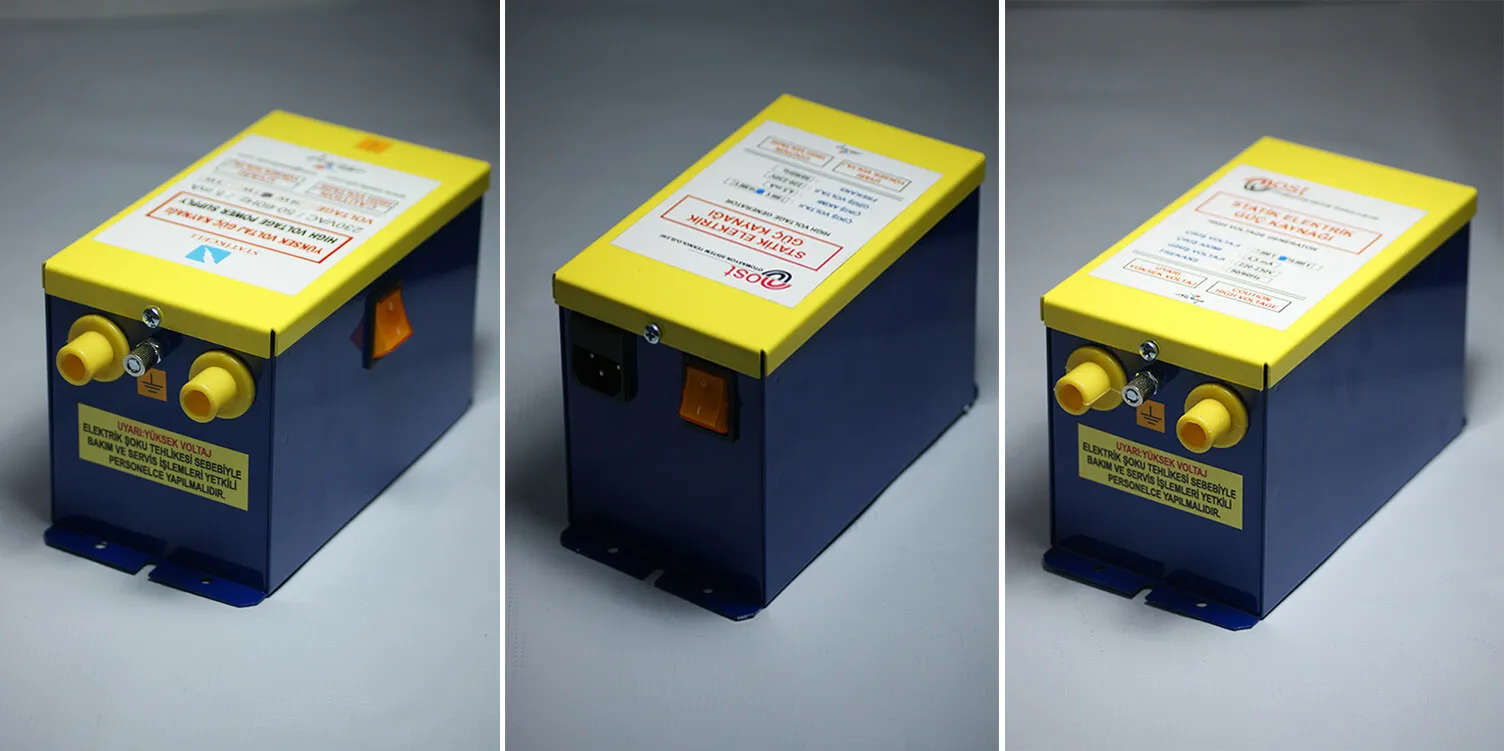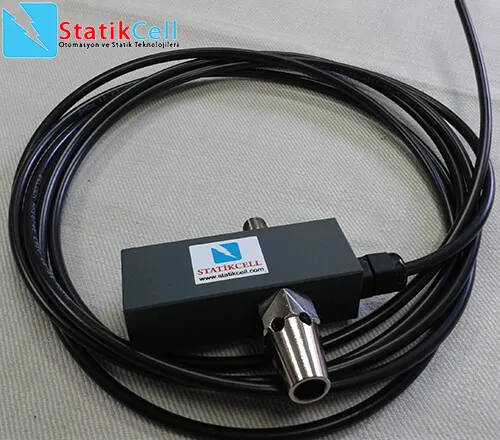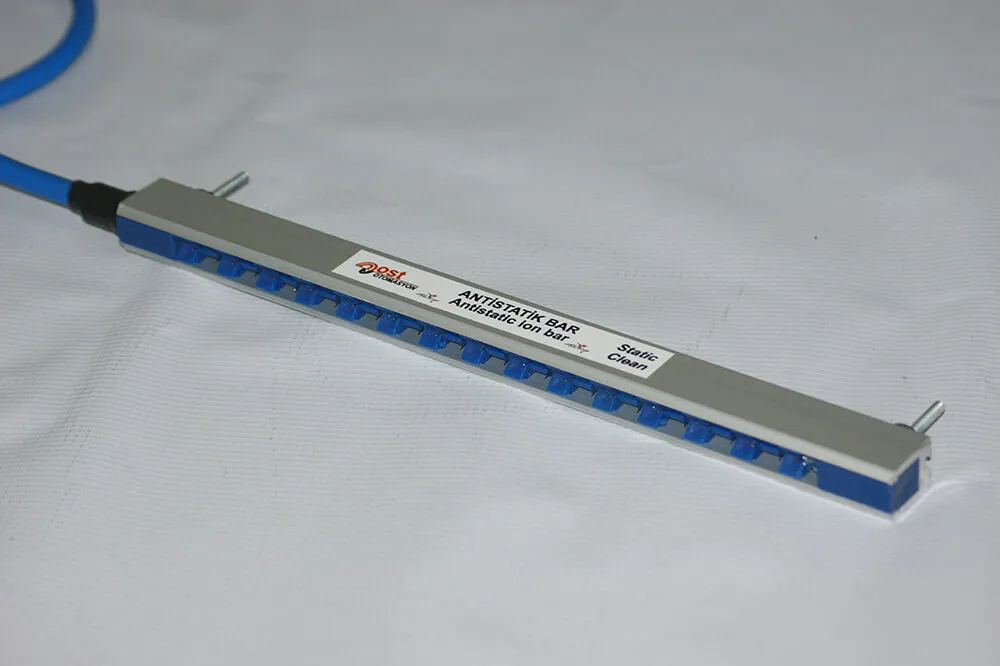
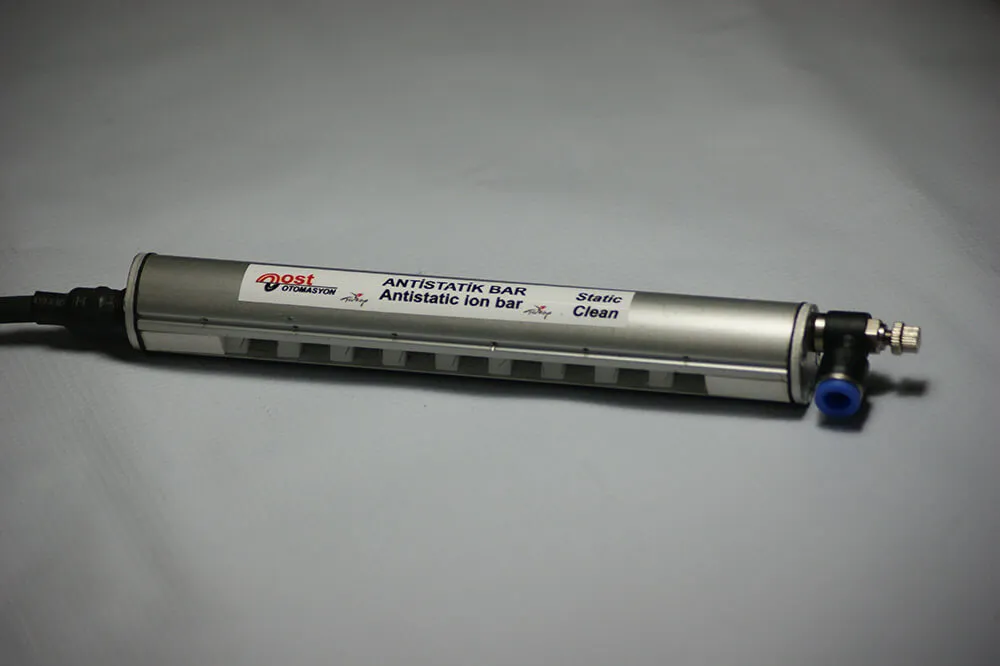
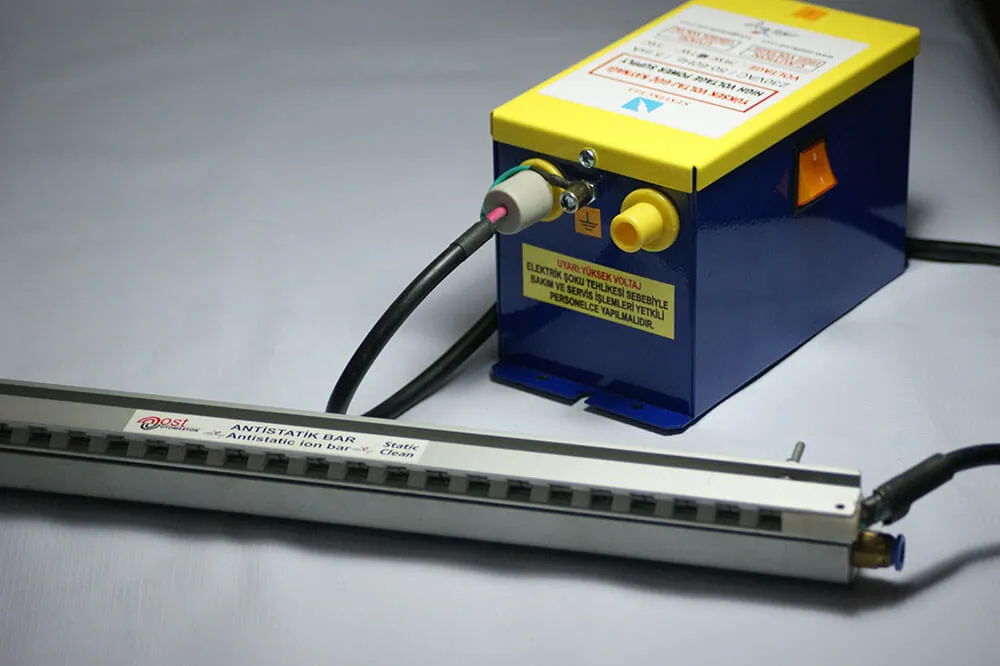
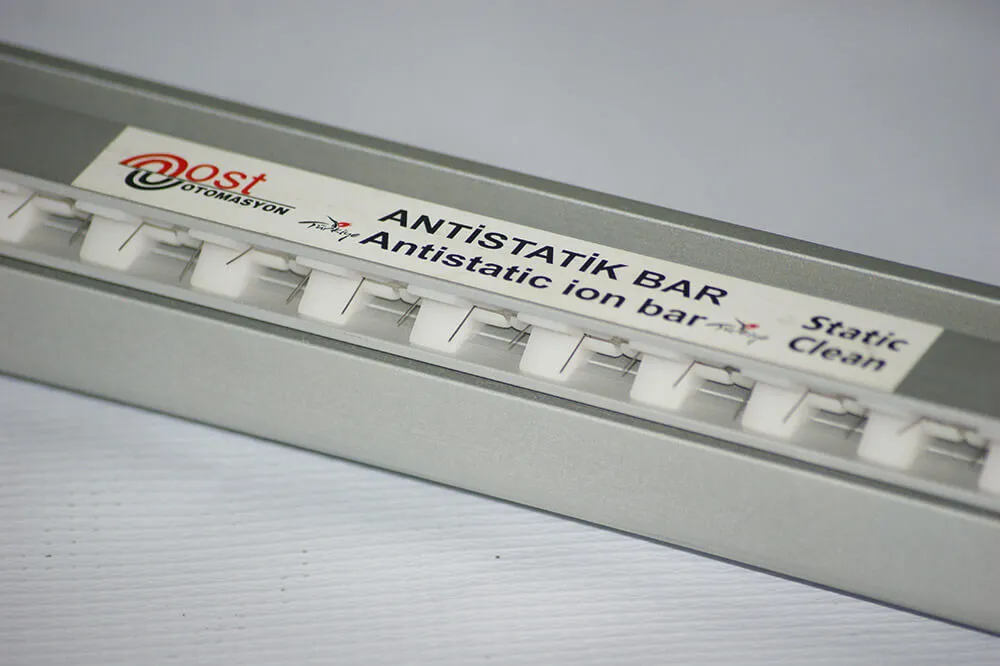
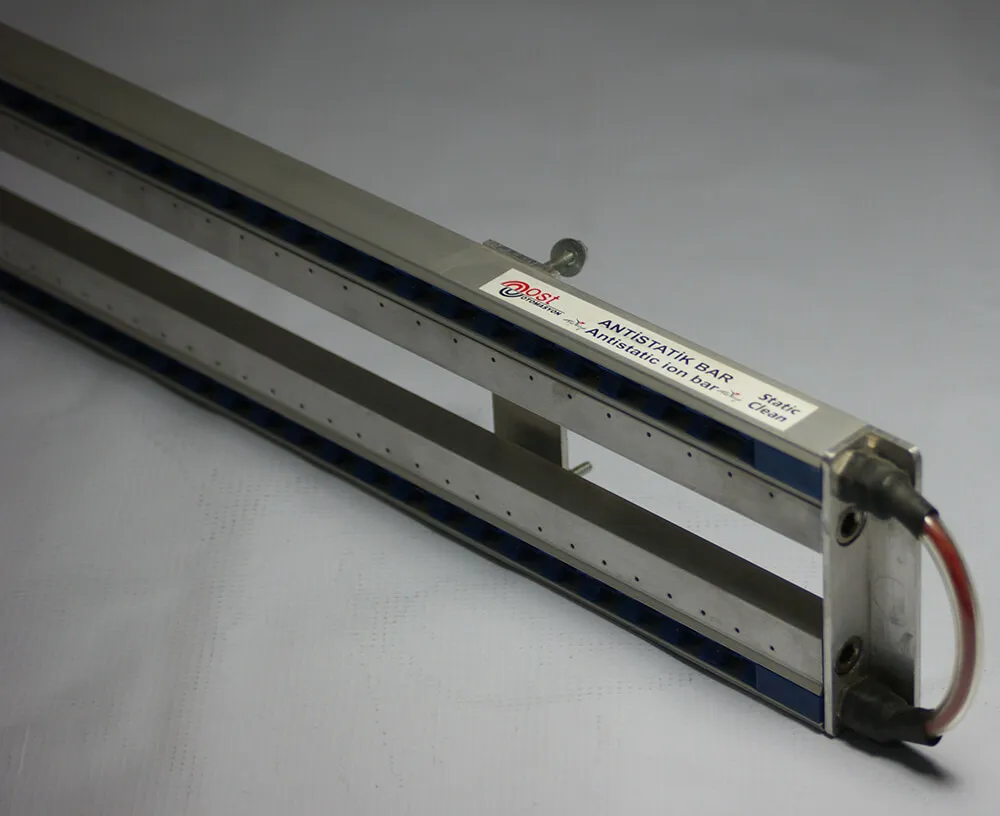
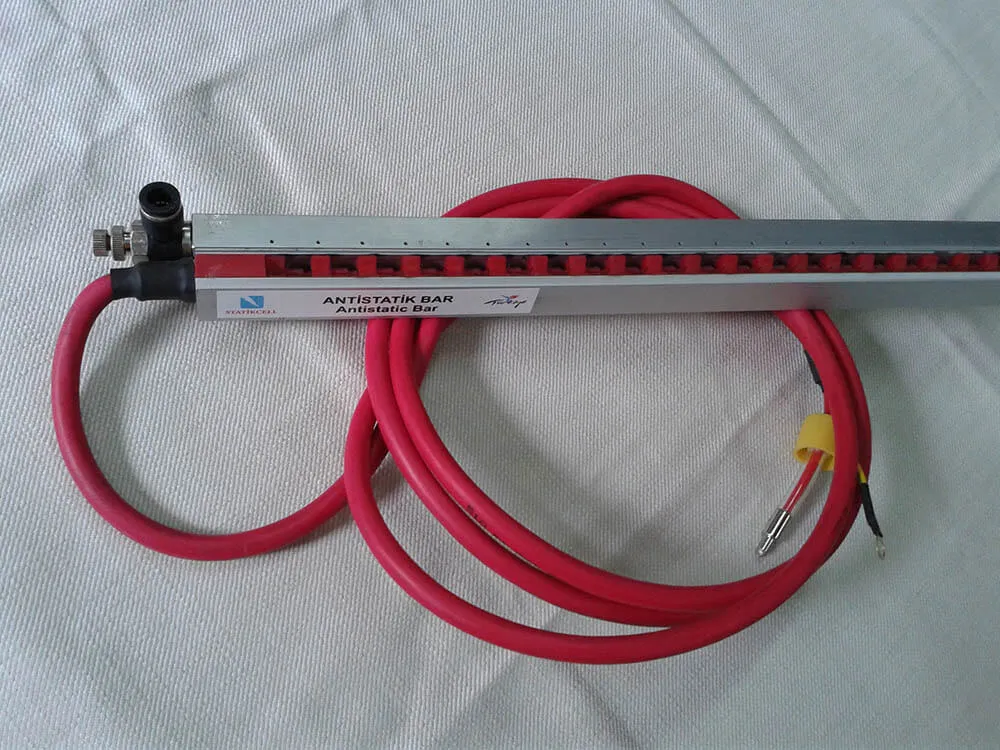
An antistatic bar (also known as an ionizing bar or static bar) is the most widely used static eliminator (neutralizer). Powered by an AC high-voltage power supply, it showers positive and negative ions from the emitter pins along its length. Statikcell antistatic bars are made in two models: inductive and capacitive. The most noticeable difference between the two is how they behave in a short circuit: an inductive bar sparks from its emitter pins when short-circuited, whereas a capacitive bar does not.
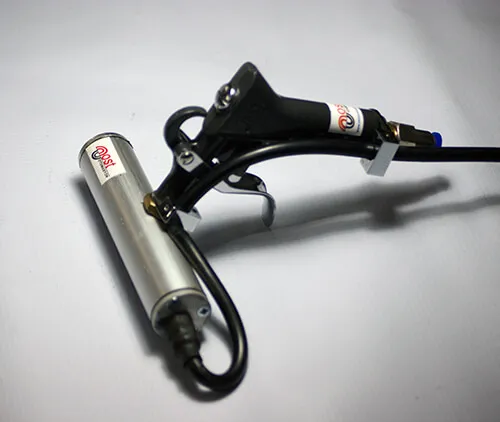
The effective working distance of the bars is a maximum of 4 cm. For applications beyond this distance, models with an air attachment can be used to extend the working distance to up to 50 cm. A key advantage of Statikcell antistatic bars is that they can be repaired, because every part can be disassembled.
How does an antistatic bar work?
Insulating materials such as plastic film, paper and fabric readily pick up static charge through friction, separation from rollers and unwinding from the reel. Because they are insulators, this charge does not dissipate on its own and remains on the surface. An antistatic bar solves this problem by ionization: the AC high voltage from the power supply creates a strong electric field at the sharp tips of the emitter pins on the bar, and the surrounding air is ionized by corona discharge. Because the voltage constantly changes direction, the pins alternately produce both positive and negative ions.
A charged material surface attracts ions of the opposite polarity to its own charge; these ions balance the surface charge and neutralize the static electricity. Because ions quickly recombine in still air, standard bars work close to the material. In air-assisted models, compressed air carries the ions to surfaces further away, increasing the effective distance.
Where are antistatic bars used?
Antistatic bars are used in many industries, above all plastics, printing and textiles, but also wood-based panels, chemicals, electronics, glass, pharmaceuticals, natural and synthetic leather, nonwovens and EPS foam production. In plastic film and sheet production, static charge causes layers to stick together and the surface to attract dust. In printing, dust clinging to the surface before printing can cause print defects, and sheets sticking together can cause feeding problems. Other common problems include fibers fluffing up and wrapping around the machine on textile and nonwoven lines, sensitive components being affected by electrostatic discharge in electronics production, and dust clinging to glass and acrylic surfaces. In addition, operators who touch charged materials can receive unpleasant electric shocks.
Choosing the right model
When choosing an antistatic bar, the first thing to consider is the distance between the bar and the material: standard bars are suitable for distances of up to 4 cm, while air-assisted models should be considered for greater distances. The bar length is determined by the width of the material or reel; Statikcell bars can be manufactured in one piece from 10 cm up to 4 m. In applications where sparking in the event of a short circuit is undesirable, the capacitive model has the advantage.
Installation is very straightforward. The plug-in cable makes connection quick, and the high-voltage cable designed specifically for Statikcell is rated for voltages of up to 60 kV. The built-in grounding cable removes the need for extra cable runs and labor. The screw channel on the back (YSB screw) allows the bar to be adjusted and mounted as required, and its very slim profile means it fits even in tight gaps between machine parts.
Contact Statikcell to determine the most suitable antistatic bar model and length for your line.