Layers sticking together as a film reel unwinds, dust clinging to the surface before printing, the shock an operator feels when approaching the machine… These all have a common cause: static electricity. In this article, we summarize how static electricity forms, what problems it causes in production and how it is eliminated in industry.
How does static electricity form?
When two materials come into contact and then separate, electrons are exchanged between the surfaces. One surface gains electrons and becomes negatively charged, while the other loses electrons and becomes positively charged. On production lines, this happens all the time: as film leaves a roller, as a reel unwinds, as paper or fabric passes over cylinders, or as sheets are stacked on top of each other.
In a conductive material, this charge quickly flows away through grounding. But on insulating materials such as plastic, paper and fabric, the charge stays where it is and does not dissipate on its own. The faster the line runs and the drier the ambient air, the greater the build-up.
What problems does it cause in production?
- Sticking and feeding faults: Charged films and sheets stick to each other or to machine parts; sheets do not separate and feeding is disrupted.
- Dust attraction: A charged surface attracts dust from the air. In printing, this means print defects and waste; on plastic and glass surfaces, it means quality problems.
- Wrapping and fluffing: On textile and nonwoven lines, fibers fluff up and the material can wrap around the machine.
- Electric shocks: Operators who touch charged material can receive unpleasant shocks, sometimes strong enough to trigger a reflex movement.
- Damage to sensitive parts: In electronics production, electrostatic discharge can damage components.
Measure first
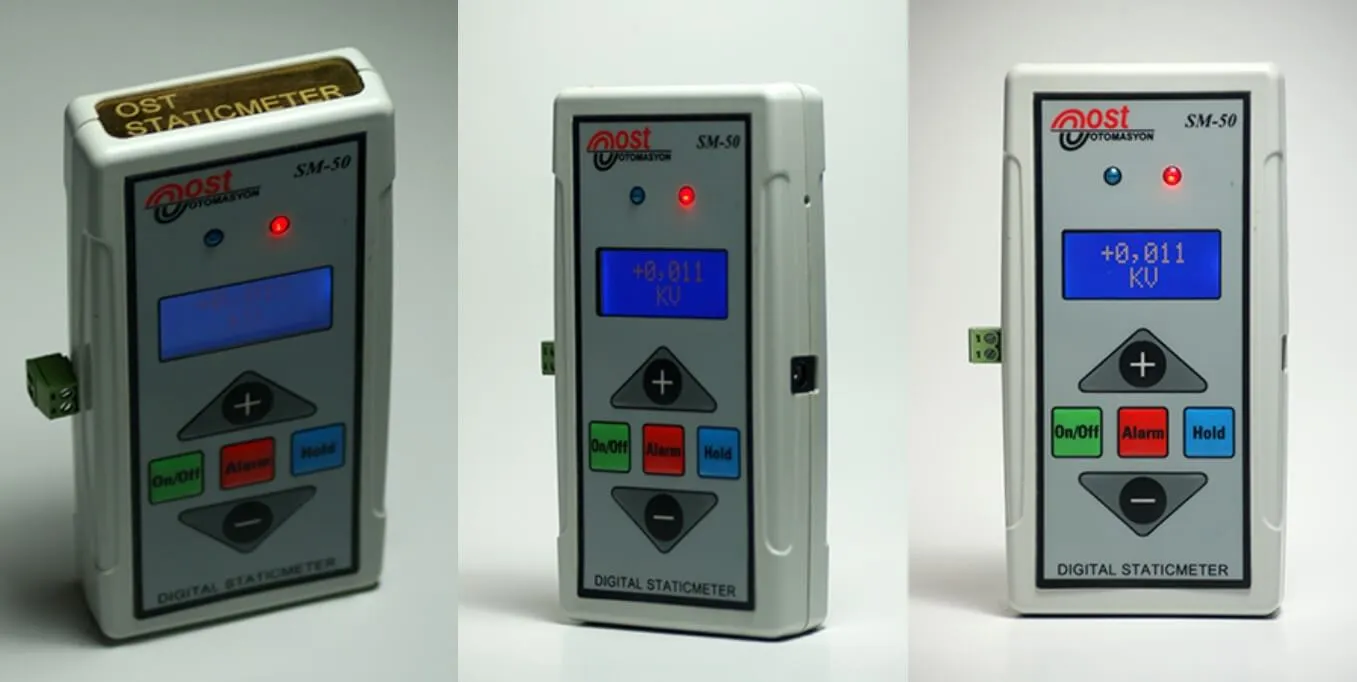
The first step in solving a static problem is to measure it. A static meter shows the level and polarity (+/−) of the charge on the surface. Identifying the point on the line where the charge builds up is a prerequisite for putting the right equipment in the right place. Measuring again after installation also confirms whether the solution is working.
Eliminate it by ionization
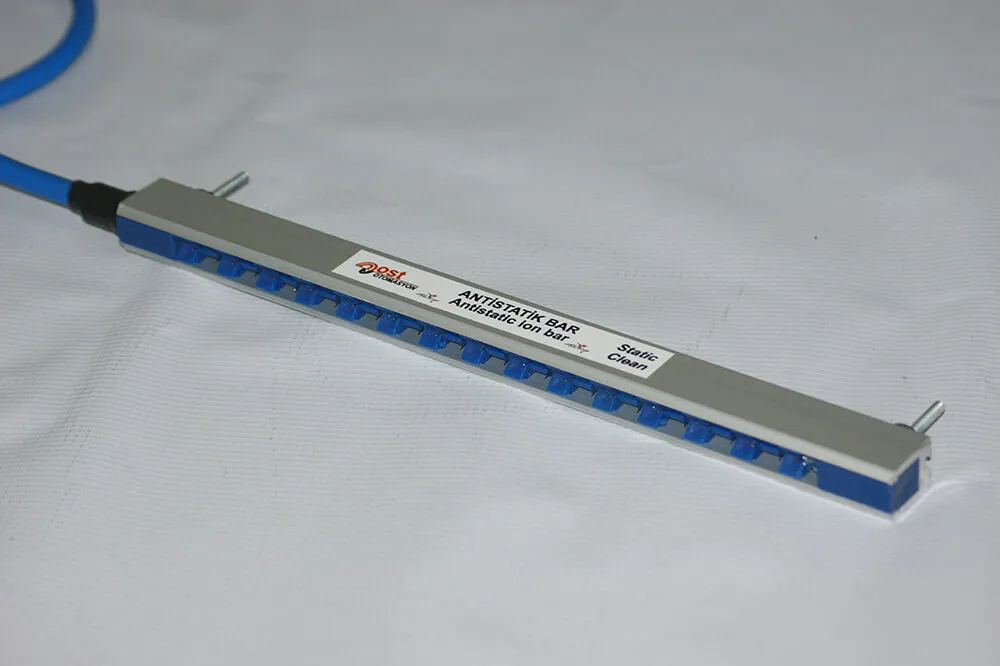
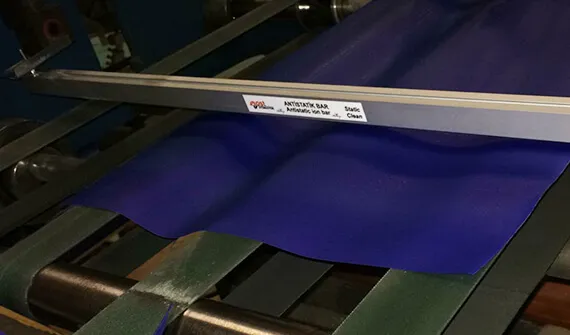
In industry, static electricity is most commonly eliminated by ionization. Antistatic bars create a strong electric field at emitter pin tips supplied with high voltage; the surrounding air is ionized and both positive and negative ions are produced. The charged surface attracts ions of the opposite polarity to its own charge, and its charge is balanced: the material becomes neutral.
Different equipment is used depending on the requirement:
- Antistatic bar: The most common solution for continuous neutralization on the line. Standard bars work close to the material (up to 4 cm).
- Air-assisted bar and nozzle: Compressed air carries the ions further (up to 50 cm) or into tight spots where a bar will not fit.
- Antistatic air gun and blower: For cleaning parts, assembly and large work areas.
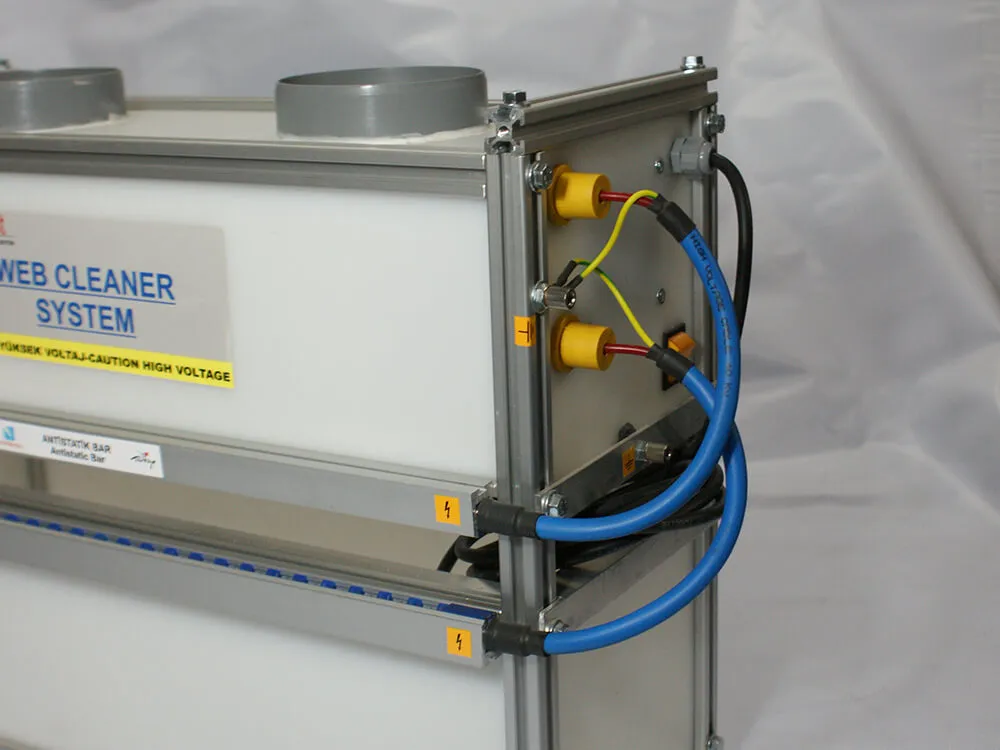
- Web cleaner: Eliminates the static charge and removes dust from the surface with compressed air and vacuum; ideal for cleaning before printing.
Sometimes static electricity is wanted
Static electricity is not always a problem. In static charging (pinning) applications, the material is charged deliberately, so that surfaces adhere to each other temporarily without any mechanical fixing, as in in-mold labeling (IML) or the production of melamine-faced MDF and particleboard.
Finding the right solution
Every line is different. The material type, line width and speed, the distance from the equipment to the material and whether compressed air is available on the line determine the right solution. At Statikcell, with 20 years of industry experience, we diagnose the static problem on your line on site and work with you to determine the solution that suits your application.