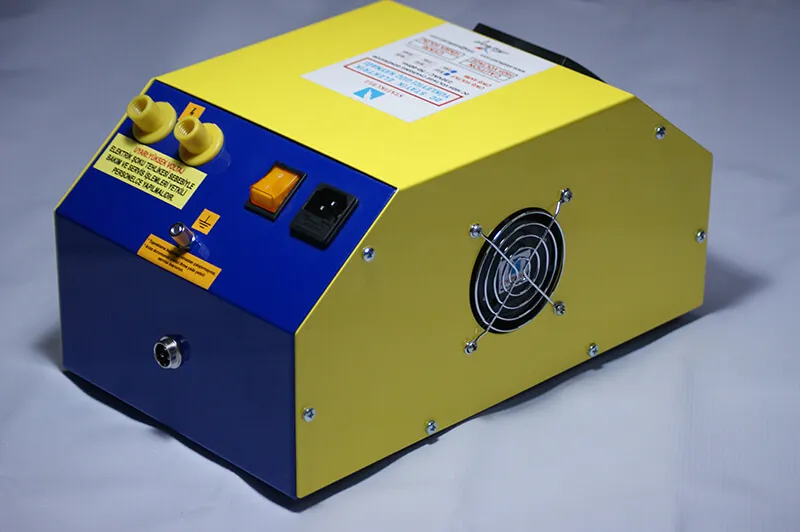
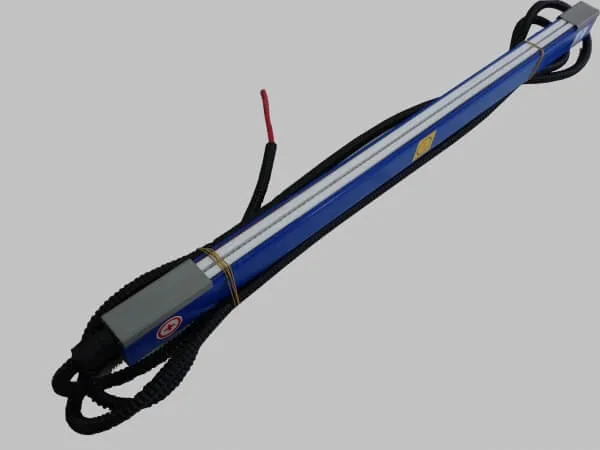
Instead of eliminating static electricity, static charging systems create it deliberately and in a controlled way. Charging bars supplied by a DC high-voltage power supply give the material a single-polarity charge, so that materials such as film, labels or sheets temporarily adhere to each other or to a surface without any mechanical fixing. This method is called static charging or pinning.
What does a charging system consist of?
| Component |
Confirmed values |
Function |
| DC static charging bar |
10–400 cm long; fully insulated body |
Charges the material with a single polarity |
| DC high-voltage power supply |
DC 20–100 kV, depending on the model; negative or positive polarity |
Supplies the high voltage the bar needs |
Because the operating voltages are high, charging bars, unlike static eliminating bars, are designed with a fully insulated body; this construction protects against the risk of arcing and insulation breakdown.
Where is it used?
In applications where the material must stay in place without slipping, such as in-mold labeling (IML), the production of melamine-faced MDF and particleboard, lamination, stacking, automatic reel changing and bag cutting.
Frequently asked questions
What is the difference between static charging and static elimination? Static eliminators use AC voltage to generate both positive and negative ions and neutralize the charge. Static charging systems, by contrast, use DC voltage to give the material a single-polarity charge and make it adhere.
How is the bar length chosen? The bar length is chosen according to the width of the material to be charged; bars can be made from 10 cm up to 400 cm.