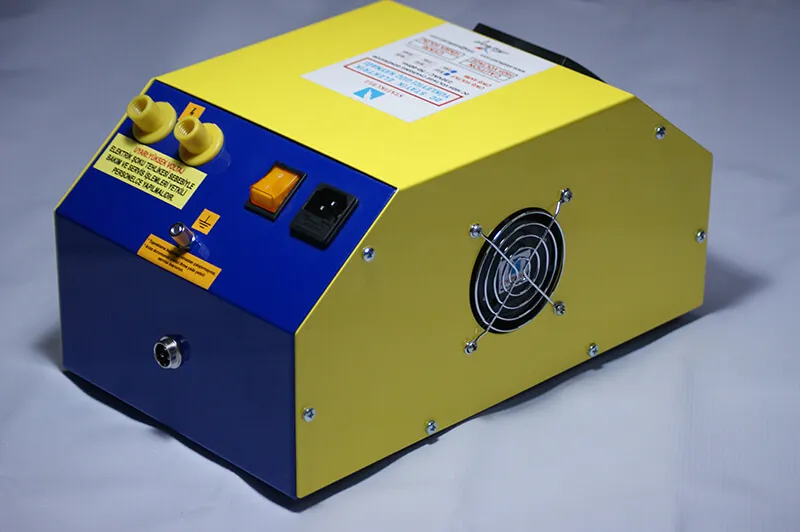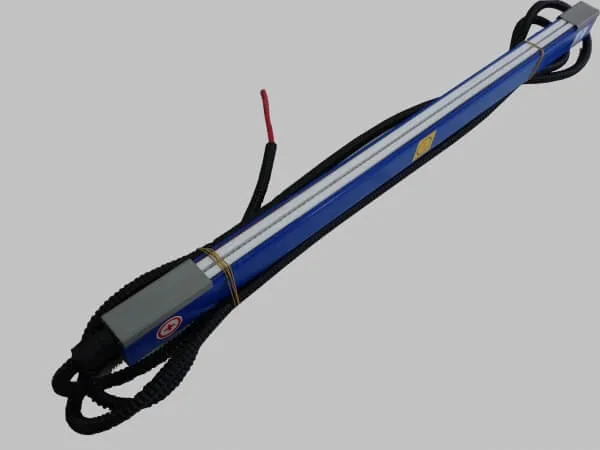
The DC static charging bar is designed for DC static charging and, unlike static eliminating (neutralizing) bars, has a fully insulated body and components. The reason is that the operating voltage here reaches much higher values of 20–100 kV, and at these levels the risk of arcing and insulation breakdown increases. The bar can be manufactured from 10 cm up to 400 cm; the standard cable length is 2.5 meters and can be extended on request.
How does a DC static charging bar work?
While antistatic bars neutralize charge by generating both positive and negative ions with AC voltage, the DC charging bar serves the opposite purpose: charging the material with static electricity in a controlled way. Supplied by a DC high-voltage power supply, the bar ionizes the air; because the voltage is unidirectional, only ions of one polarity move toward the material and accumulate on its surface.
The charged material is drawn by electrostatic force to a surface that is grounded or at a different potential. This method, also known as pinning, makes two surfaces adhere to each other with no air in between (for example, a double-layer bag), or makes a material adhere temporarily to another material or to a mold surface (for example, IML labeling). No mechanical fastening or adhesive is used in this method; adhesion is achieved entirely by electrostatic attraction.
Where is the DC static charging bar used?
The main applications of the product are the production of melamine-faced particleboard and MDF, and IML (in-mold labeling). In in-mold labeling, the label must stay on the mold surface without slipping until the plastic is injected; static charging makes the label adhere temporarily to the mold. In the production of melamine-faced particleboard and MDF, it is used where temporary adhesion is needed, for example to keep layers placed on the board in position until the next process. In products such as double-layer bags, it makes the two film layers adhere to each other with no air in between.
Factors affecting adhesion
The adhesion achieved by static charging is temporary, not permanent, and how long it lasts depends on several conditions. Seasonal temperature changes, the humidity of the ambient air and the conductive resistance of the material directly affect this duration. In humid air, the material surface becomes more conductive and the charge dissipates faster, whereas materials with a high conductive resistance hold the charge longer. As a result, the same line may need different settings in summer and winter. When designing the application, the ambient conditions and the material properties should be considered together.
For the right solution, information such as the material type and width, the surface the material needs to adhere to, the mounting distance of the bar and the required bar length is important. The bar length can be specified to suit the application within the range of 10–400 cm.
For IML, melamine-faced MDF and particleboard or similar static charging applications, contact Statikcell for application-specific advice.