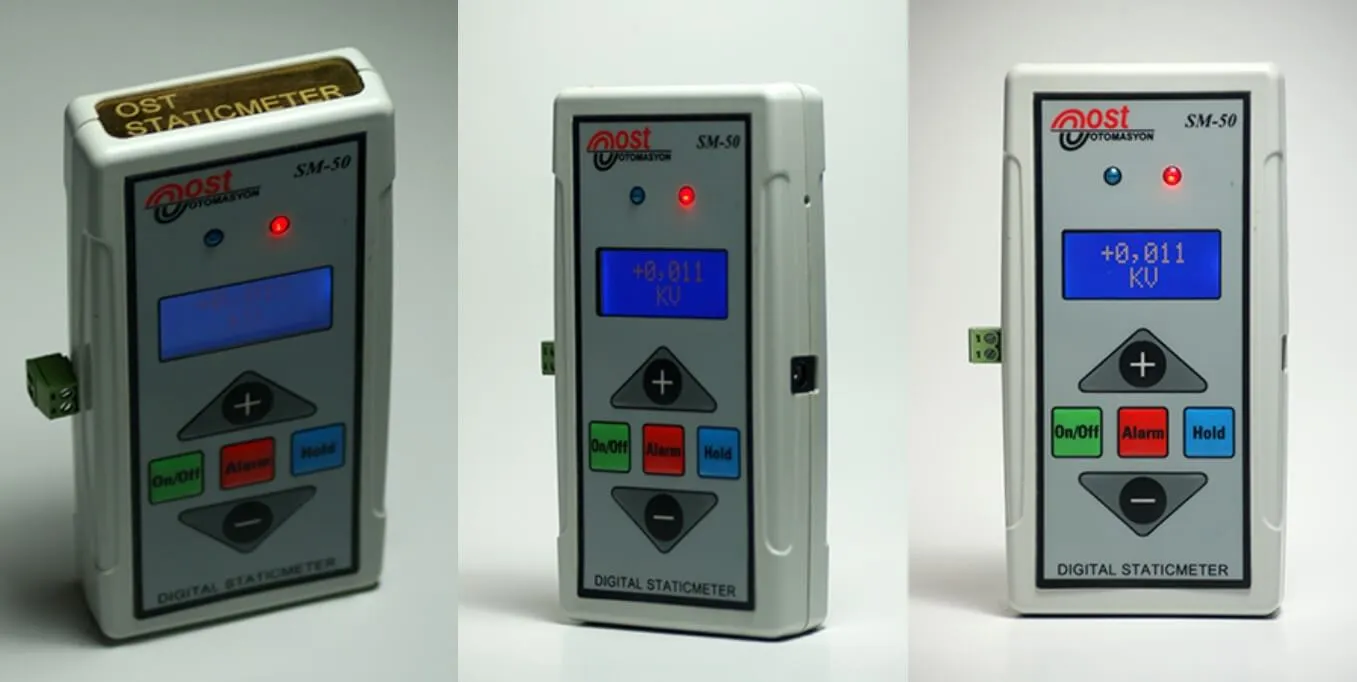
The static meter is a digital static electricity measuring device used to detect the static charge on materials classed as insulators, such as plastic, paper and fabric, and the polarity (+/-) of that charge. With a measuring range of 0–200 kV and a sensitivity of 1 V, the device measures from a distance of 1–10 cm. In addition to the main display, it shows the ion polarity (+/-) by LED, and it offers a hold function to freeze the measured value on the display, ambient calibration, an adjustable alarm set point and automatic shut-off. The static meter can run on a 9 V battery or an adapter and is easy to mount on the machine thanks to the magnet on the metal plate at the back.
How does a static meter work?
A statically charged surface creates an electric field around it. The static meter detects this field without contact and shows the charge on the surface on the display as a voltage (kV). The direction of the measured field shows whether the charge is positive or negative; the device presents this information both on the main display and with a separate LED indicator.
Because the field strength varies with the distance from the surface, the measuring distance has a decisive effect on the result. The device is designed to measure from a distance of 1–10 cm. For reliable, comparable results, it is recommended to take measurements from the same distance each time. The ambient calibration function allows the device to be adjusted to its surroundings. The hold function freezes the measured value on the display, which is convenient when the device is used at points where the display is hard to read.
Where is the static meter used?
The static meter is designed to be used for measurement wherever static electricity is present. On insulating materials such as plastic film, paper and fabric, static charge can cause dust attraction, layers sticking together, feeding problems on the machine and electric shocks to operators. The first step in solving these problems is to determine accurately where the charge builds up, its level and its polarity.
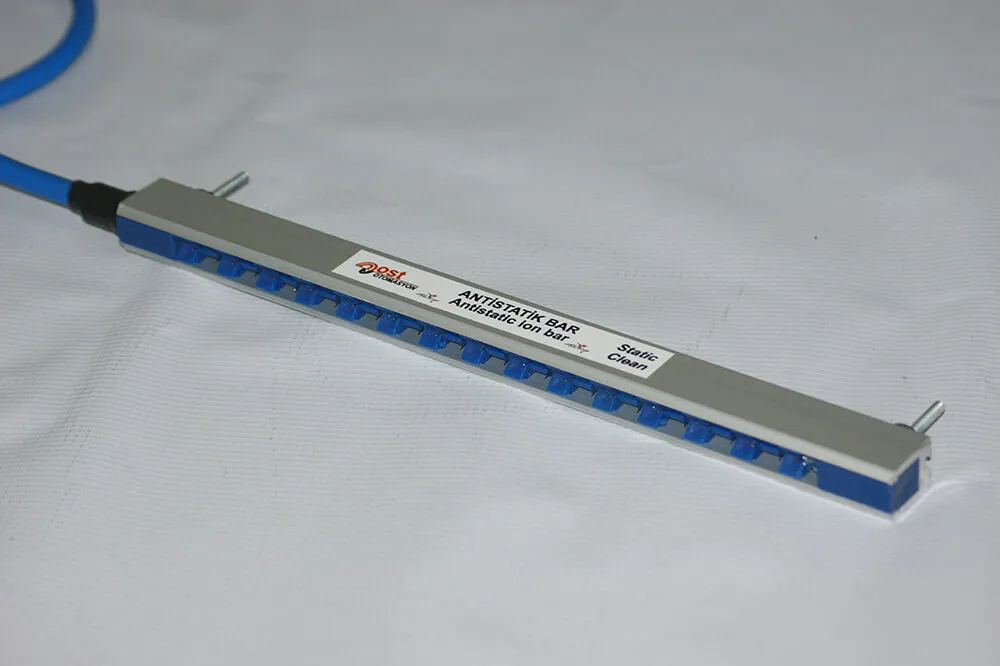
With this information, you can determine where on the line a static eliminator (ionizer) is needed. After installation, the effectiveness of antistatic bars or other equipment can be verified by measuring the charge on the material before and after the ionizer. Polarity information is also useful, particularly in static charging (pinning) applications, for seeing which polarity the material has been charged with.
In applications that require continuous monitoring, the device can be powered by an adapter and used as a fixed measuring point on the line. In this mode, the device provides a visual and audible alarm output (max. 24 V – 1 A) when the alarm set point is exceeded. The magnetic metal plate at the back makes it easy to place the device on the machine.
Tips for accurate measurement
Before measuring, it is recommended to carry out the ambient calibration and to take measurements from a constant distance within the 1–10 cm range. A value measured directly above grounded rollers may appear lower than it really is because of the nearby grounded surface, so measuring on a section of the material away from the rollers gives a more accurate result. Because readings can fluctuate on moving lines, taking several measurements and comparing them gives a sound result.
Contact Statikcell for information on static electricity measurement and solutions that suit your application.