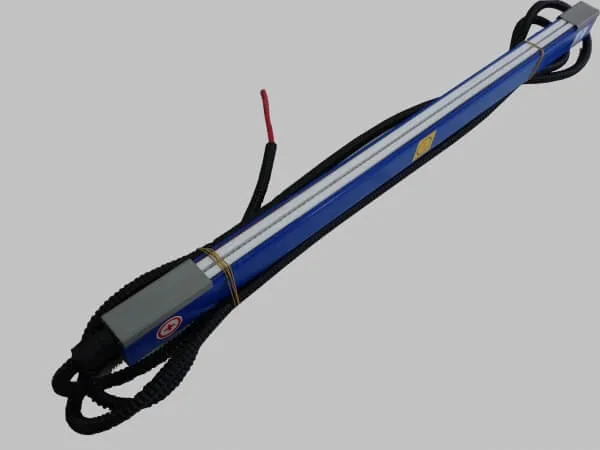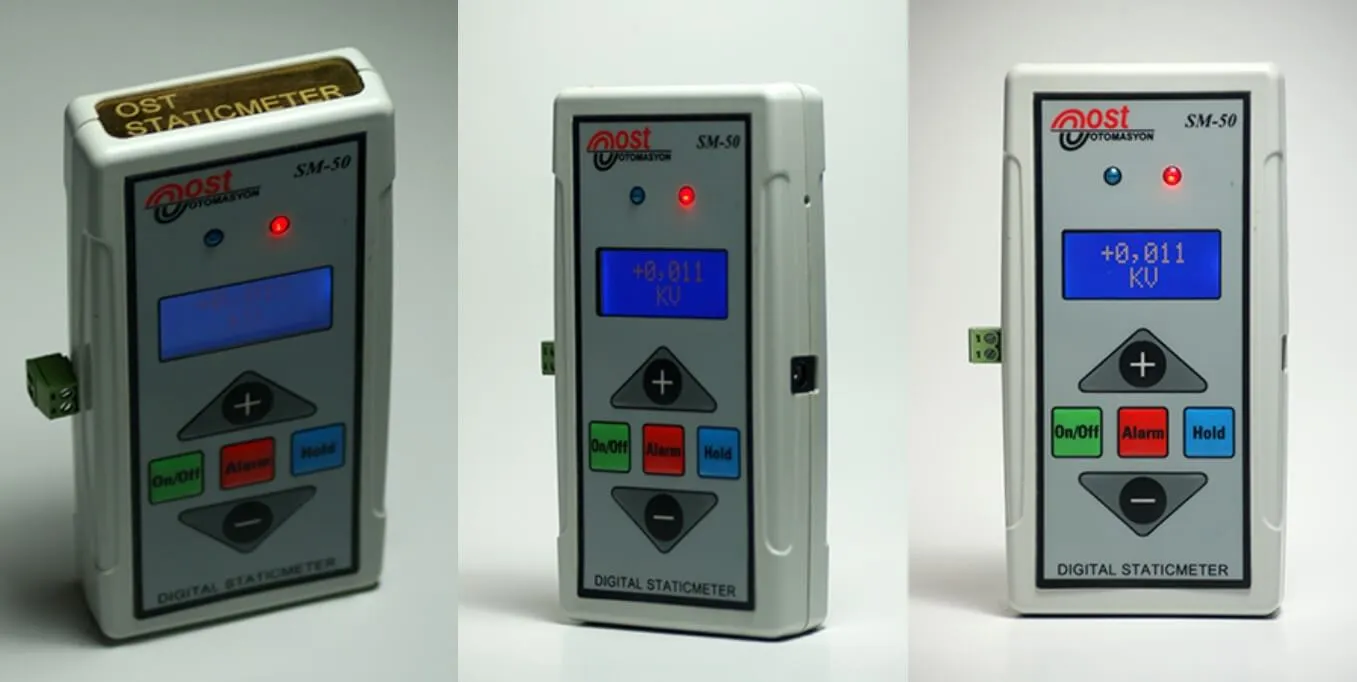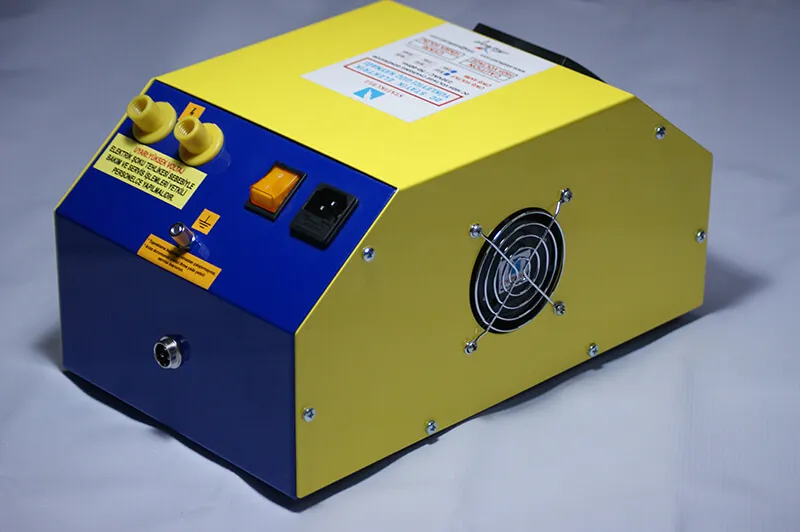
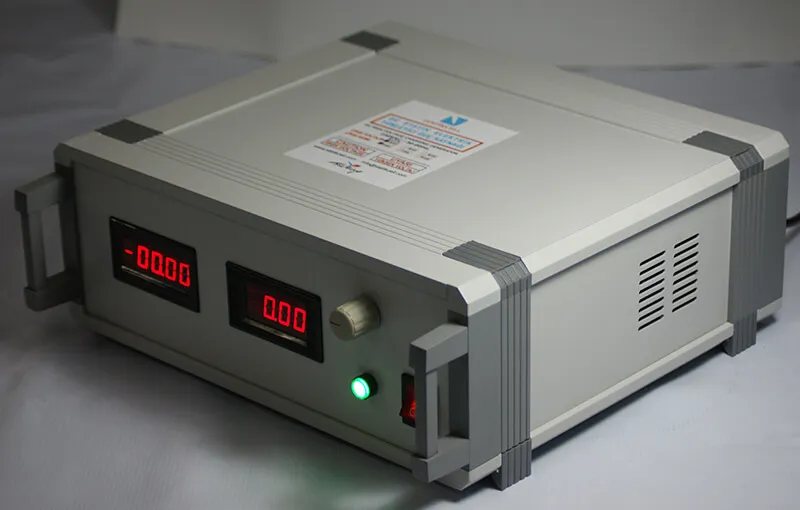
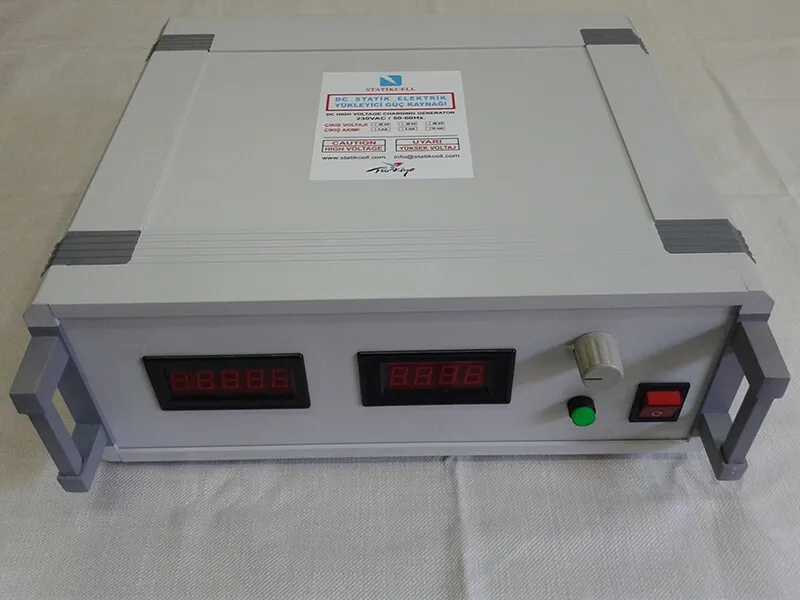
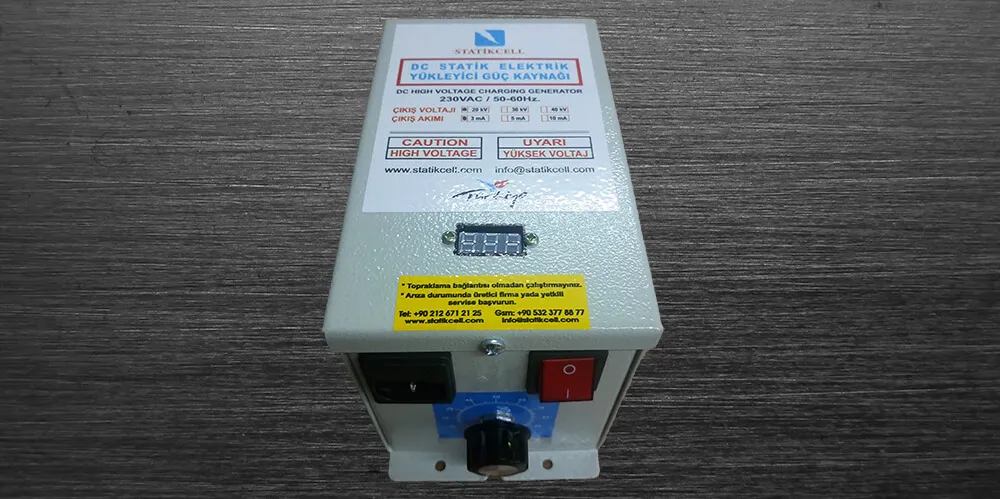
The DC static charging power supply is a high-voltage power supply available in models from 20 to 100 kV, with an output current of 3, 5 or 10 mA, depending on the model, and negative or positive polarity depending on the application. Unlike AC systems that eliminate static electricity, it is used to charge the material with static electricity in a controlled way to achieve temporary adhesion (pinning). The output voltage can be set on the digital display, the response time before overcurrent protection trips can be adjusted, and the output can be switched on and off by the connected system or from an external point. The unit has 2 socket outputs.
How does a DC static charging power supply work?
The DC power supply converts the mains voltage into single-polarity high voltage and delivers it to the DC static charging bars. The strong electric field at the electrodes on the bar ionizes the air; however, because the voltage is direct current, only ions of one polarity (positive or negative) move toward the material. These ions accumulate on the material surface and charge it.
The charged material is drawn by electrostatic force to a surface that is grounded or at a different potential. This allows two surfaces to adhere to each other with no air in between, or a material to adhere temporarily to another material or to a mold surface. Because the voltage can be set on the digital display, the holding force can be adjusted to suit the material and the process. The remote on/off function makes it easier to synchronize the charging process with the machine cycle.
Where is the DC static charging power supply used?
It is used in many applications, above all in plastics and wood-based panels. In in-mold labeling (IML), the label has to stay in place on the mold surface without slipping until the plastic is injected; static charging provides this temporary adhesion. In bag cutting, stacking, edge bonding and strip laying applications, the aim is to hold layers neatly together; on automatic reel changing and multi-lane feed lines, it is to keep the material in place by making it adhere.
DVD production, laminating, vacuum shrink wrapping and electrostatic bonding are also among the main applications. It is also used in static charging applications in the production of melamine-faced MDF and particleboard. In addition, it can be used to test insulating containers that must be leak-tight for holes and cracks: the intact wall withstands the high voltage, while a flashover occurs at a hole or crack, revealing the defect.
Information needed for a quote
To determine the right power supply, it helps to know the type of application (labeling, stacking, lamination, etc.), the material processed and its thickness, the surface it needs to adhere to, the number and length of the charging bars to be used, the line speed and whether integration with the machine control system is required. The ambient temperature and humidity should also be taken into account, as they affect holding performance.
Contact Statikcell to determine the right voltage, polarity and system design for your static charging application.