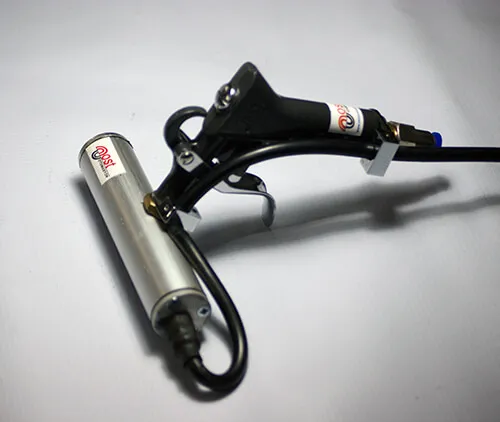
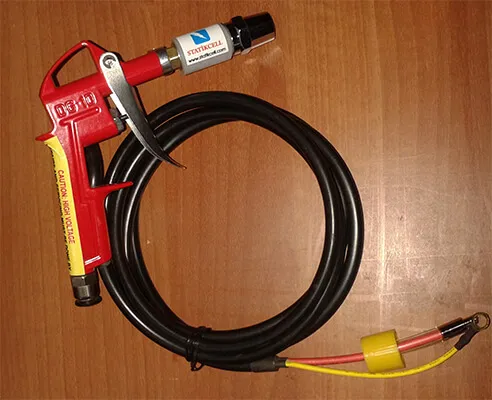
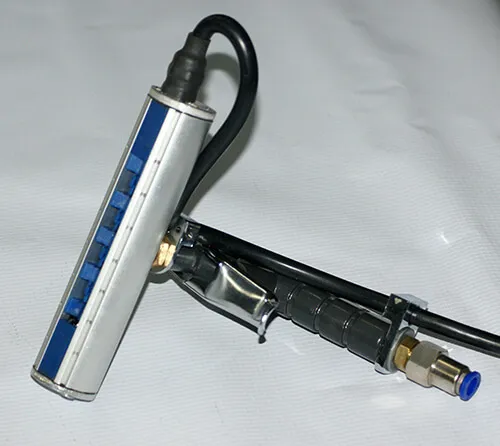
The antistatic air gun is an ionizing air gun assisted by compressed air that lets you apply static elimination by hand, preferably on small products that need their static electricity removed. It removes the static charge on the material and cleans away dust particles clinging to the surface. With an effective distance of 500 mm, the air gun is used with an AC 5–7 kV (5 mA) power supply and runs on dry, clean compressed air at 5–6 bar. The standard cable length is 2.5 meters.
How does an antistatic air gun work?
The head of the air gun contains ion emitter pins supplied with AC high voltage from the power supply. The strong electric field at the sharp pin tips ionizes the surrounding air by corona discharge, producing positive and negative ions. When the trigger is pressed, the compressed air flowing through picks up these ions and carries them to the target surface as ionized air.
The statically charged surface attracts ions of the opposite polarity to its own charge, and the charge is neutralized. Once the electrostatic attraction that binds the dust to the surface is gone, the same airflow lifts the dust particles off the surface and carries them away. When blowing with compressed air alone, the charge stays in place, so the dust may not separate completely or may soon return to the surface. What sets the antistatic air gun apart is that it eliminates static electricity and removes dust at the same time.
Where is the antistatic air gun used?
The antistatic air gun is used in areas such as molds and molding, optics, cleaning of automotive parts, screen printing, plastic sheet, cleaning of electronic parts, cleaning before painting, cleaning and neutralization of 3D parts, lens cleaning, the furniture industry and packaging.
What these applications have in common is that even a tiny speck of dust on the surface directly affects quality. When cleaning before painting, dust left on the surface shows up as roughness and surface defects in the paint layer. In screen printing, dust causes print defects. Optical parts and lenses must be free of dust, while plastic sheets and molded parts hold dust strongly because of their static charge. In electronic parts, static electricity not only makes dust cling but also poses a risk to sensitive components. Because it can be aimed by hand, the air gun is a practical solution for small parts of different shapes and sizes.
Tips for efficient use
For the air gun to work efficiently, the air supply must be dry and clean, at 5–6 bar. Moisture and oil in the air can contaminate the ion emitter pins, reduce ion output and be carried onto the surface being cleaned, so the air treatment equipment on the line should be well maintained. During use, the air gun should be aimed at the surface within its effective distance of 500 mm.
When planning the installation, consider the existing compressed air line, the distance between the work station and the power supply, and the size of the parts to be cleaned together. The standard cable length of 2.5 meters should be taken into account when positioning the power supply.
Contact Statikcell for the antistatic air gun and power supply combination that suits your application.