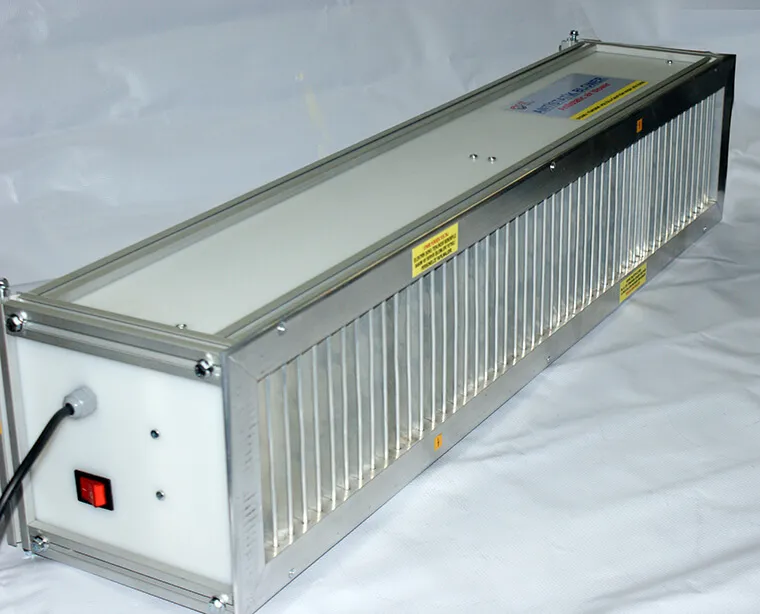
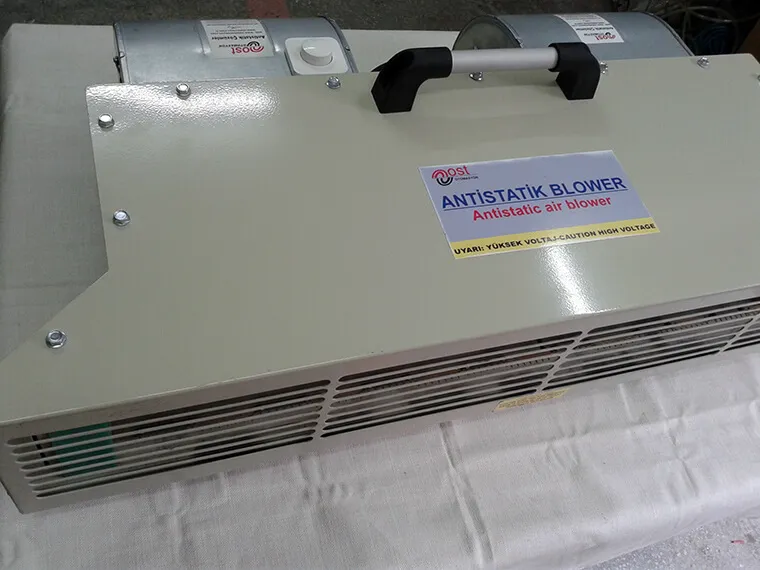
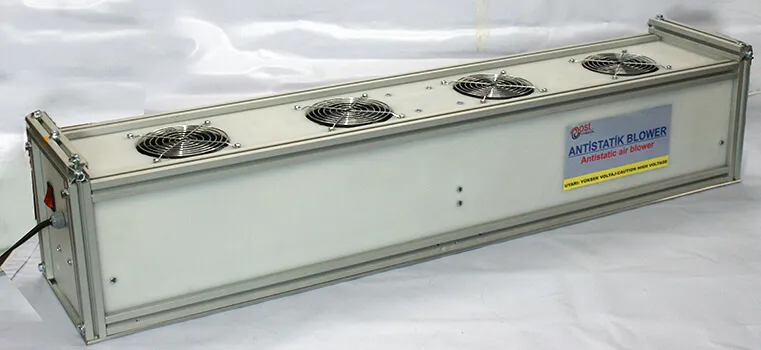
The ionizing blower (antistatic blower) is a fan-assisted static eliminator built to ionize over long distances (1–2 m). The speed of its built-in fan is controlled with a dimmer, so the effective distance of the ionized air can be increased or decreased to suit the application. Statikcell ionizing blowers stand out because the high-voltage transformer and the speed control unit are combined in a single housing, inside the unit itself. This design removes the need to find space and run cables for a separate transformer or control box.
How does an ionizing blower work?
Inside the blower are ion emitter pins supplied with high voltage. The strong electric field at the sharp pin tips ionizes the surrounding air by corona discharge, producing positive and negative ions. However, ions recombine quickly in still air and lose their effect. For this reason, pin-based static eliminators are only effective over short distances without an additional airflow.
The ionizing blower overcomes this limit with the help of a fan. The airflow created by the fan carries the ions generated to surfaces several meters away before they can recombine. The statically charged surface attracts ions of the opposite polarity to its own charge, and the charge is neutralized. When the fan speed is increased with the dimmer, the ionized air reaches further; when the speed is reduced, the area covered becomes smaller. Its ability to ionize a large volume without compressed air makes the blower particularly suitable for applications where it is difficult to get close to the material.
Where are ionizing blowers used?
The ionizing blower is used in reel and sheet processing applications such as XPS production lines, coating, lamination, sheet extrusion, slitting, winding and warping. In these processes, static charge builds up as the material separates from rollers or is cut. The charged material attracts dust, layers stick to each other or to machine parts, and operators may receive electric shocks.
Electronics assembly and cleanroom applications are also among the main uses of the blower. In these environments, static electricity can cause dust and particles to cling to surfaces and can damage sensitive components. In bottling, injection molding and vacuum forming applications, charged plastic parts can attract dust and become contaminated. In flexo printing and sheet printing applications, static charge on the surface can cause dust to cling before printing and reduce print quality.
Maintenance and efficient use
The main points of an ionizing blower that need maintenance are the emitter pins that shower ions and the filter at the fan’s air inlet. Over time, dirt building up on the pin tips reduces ion output, and a clogged filter weakens the airflow and shortens the effective distance. Cleaning these two points regularly is the most practical way to maintain the unit’s performance.
For correct positioning, the distance between the unit and the material, the width of the area to be ionized and the ambient conditions should be considered together. The fan speed can be set to a level at which the ionized air reaches the material without blowing delicate products around.
Contact Statikcell to determine the ionizing blower model and placement that suit your application.