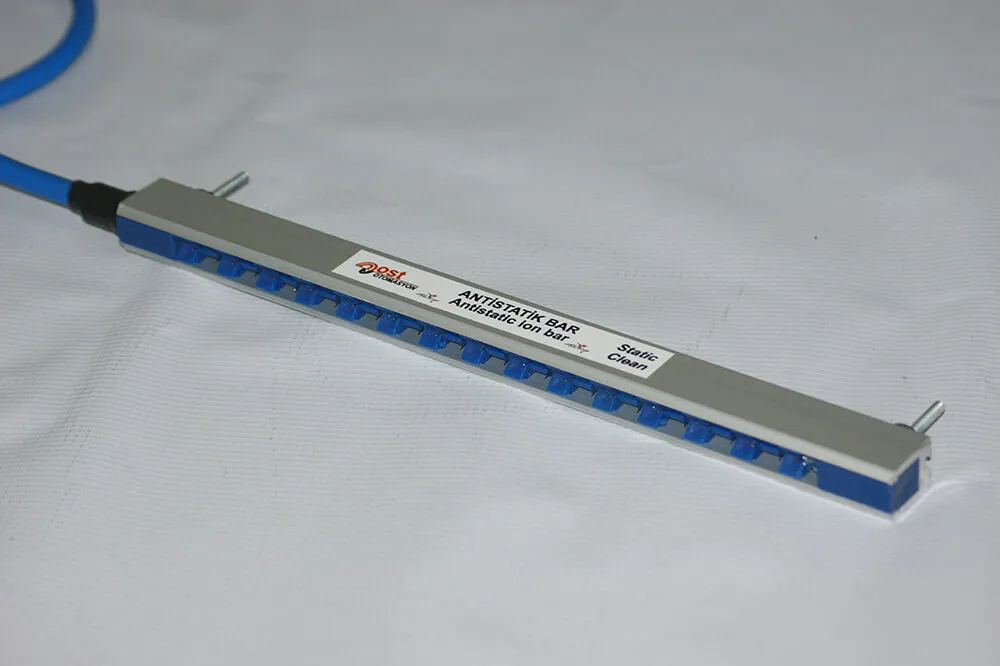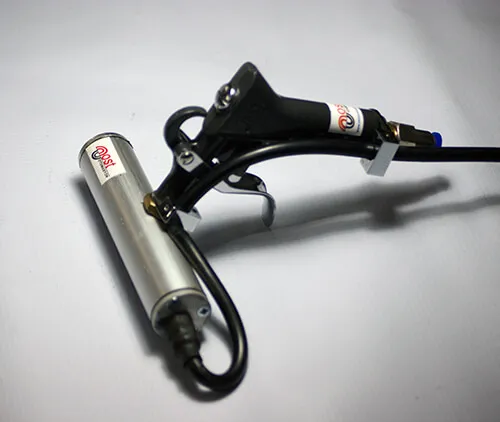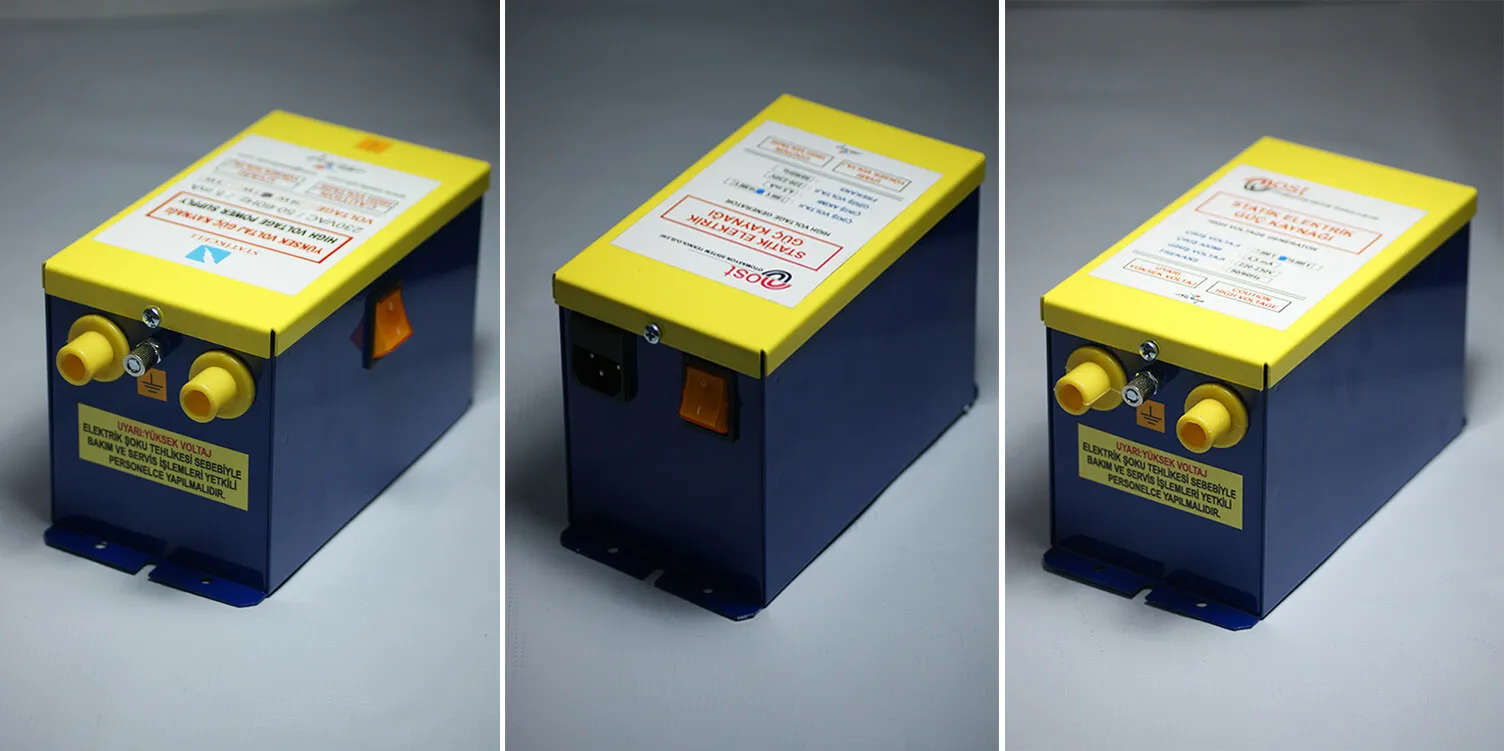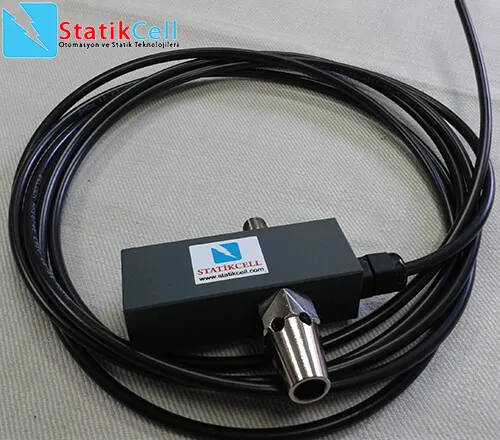
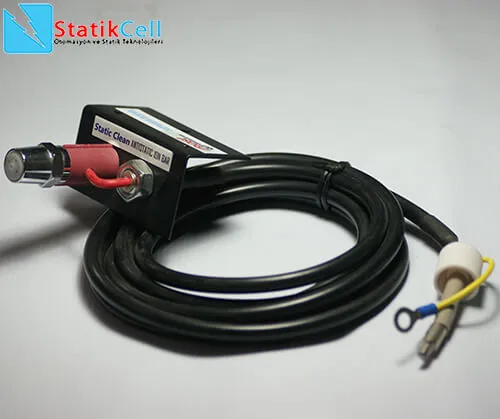
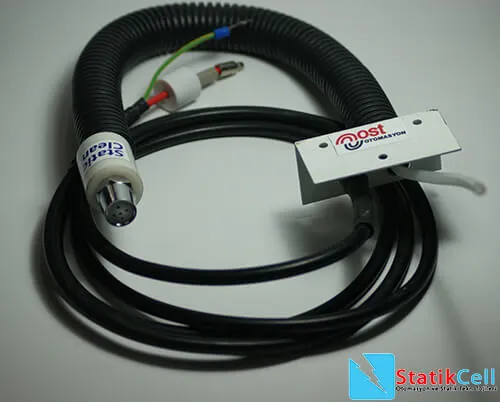
The antistatic nozzle is an ionizing nozzle assisted by compressed air, used to eliminate static electricity in narrow spaces that antistatic bars cannot reach. It removes the static charge on the material and cleans away dust particles clinging to the surface. With an effective distance of 500 mm, the nozzles are used with an AC 5 kV (5 mA) power supply and run on dry, clean compressed air at 5–6 bar. The standard cable length is 2.5 meters.
How does an antistatic nozzle work?
Inside the nozzle is an ion generator supplied with AC high voltage from the power supply. The strong electric field at the sharp tip ionizes the surrounding air by corona discharge, and because the voltage constantly changes direction, both positive and negative ions are produced. The compressed air fed to the nozzle picks up these ions and carries them to the target surface in a narrow airflow.
Because ions quickly recombine in still air and lose their effect, ionized air can only travel a very short distance without air assistance. With compressed air, the ions reach surfaces up to 500 mm away. The charged surface attracts ions of the opposite polarity and is neutralized; once the electrostatic attraction binding the dust to the surface is gone, the same airflow carries the particles away from the surface. In this way, the nozzle eliminates static electricity and removes dust at the same time.
Where are antistatic nozzles used?
Nozzles are used above all on printing presses, as well as in in-mold labeling, optics, automotive, offset printing, pad printing, plastic sheet forming, electronic parts production, cleaning before painting, lens cleaning, the furniture industry, packing and packaging.
On printing presses, static charge building up in the narrow sections of the paper or film path can make the material stick and draw dust onto the surface before printing. In in-mold labeling, static charge can cause labels to stick together and disrupt feeding. In applications where surface quality is critical, such as optical parts and lenses, or automotive and furniture parts cleaned before painting, dust left on the surface shows up directly as a quality defect. In electronic parts production, static electricity not only makes dust cling but also poses a risk to sensitive components. On packing and packaging lines, charged films can stick to machine parts and disrupt the smooth running of the line.
Points to note for correct use
For the nozzle to work efficiently, the air supply must be dry and clean, at 5–6 bar; air containing moisture and oil can impair ion generation. The nozzle should be positioned within its effective distance of 500 mm so that it directs the ionized air straight to the area where the static charge builds up. The standard cable length of 2.5 meters should be taken into account when planning the position of the power supply.
Contact Statikcell to determine the best nozzle placement for the narrow spaces in your machine.